


Strongly correlated data inference algorithm
 by
ADMIN
by
ADMIN The development of China's amino acid industry over the past 20 years has made tremendous progress. By 2023, China's amino acid production will account for over 70% of the world's total, making important contributions to the global production of livestock products. Driven by market competition, the development of supply side and application markets has presented new formats. At present, there are seven types of feed amino acids being used regularly in China, which is an important guarantee for reducing and replacing feed raw materials, improving quality and efficiency. At the same time, new technologies are flourishing in the fields of feed raw material value assessment, amino acid production and application. Production materials and labor objects have undergone rapid iteration and updating, which will become the new quality productivity of the industry and promote the new development of the amino acid and feed raw material industry.
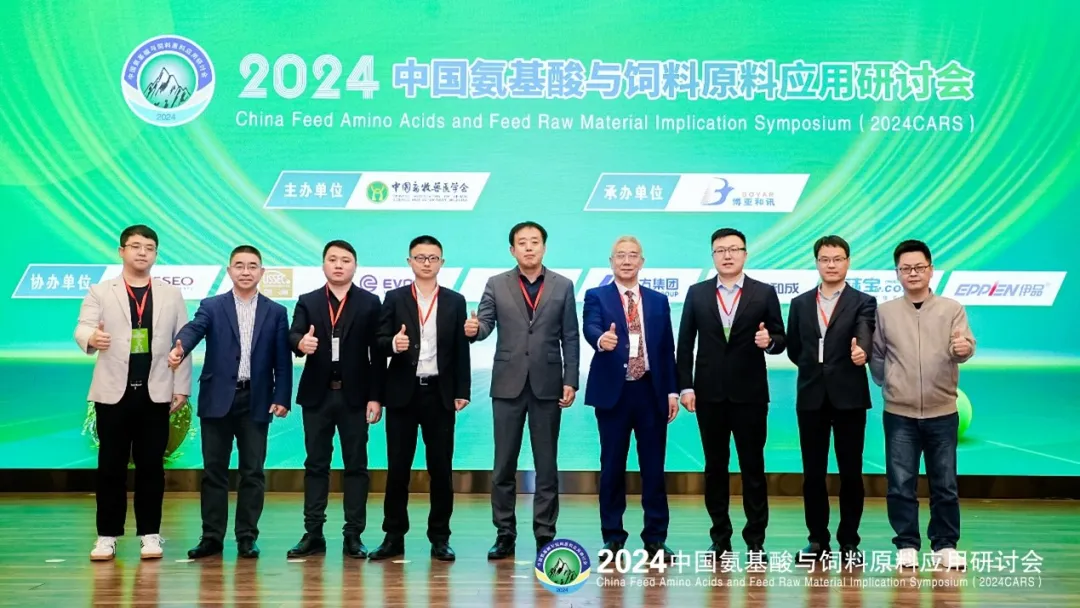
In this context, on March 29, 2024, the 16th China Symposium on the Application of Amino Acids and Feed Raw Materials, hosted by the Chinese Society of Animal Husbandry and Veterinary Medicine and organized by Beijing Boya Hexun Agricultural and Animal Husbandry Technology Co., Ltd., was held in Beijing. The experts and scholars of this seminar conducted in-depth discussions on topics such as "new formats, new technologies, and new developments" in the feed industry, including production, raw material supply and consumption, application and development of clean energy systems, value assessment of small variety amino acids, and future development directions of the amino acid industry.
The seminar was strongly supported by Andisu Life Science Products (Shanghai) Co., Ltd., American Soybean Export Association, Evonik (China) Investment Co., Ltd., CJ (Shanghai) Trading Co., Ltd., Shandong Xinhecheng Amino Acid Co., Ltd., Hainan Dingfang Technology Group Co., Ltd., Shanghai Mobao Internet Technology Co., Ltd., and Ningxia Yipin Biotechnology Co., Ltd.
In 2023, China's feed industry faced complex domestic and international situations, and the total output continued to grow at a high level, achieving unexpected development. The promotion of low protein diets has made breakthrough progress, which contains a large number of technological elements and support, and is one of the new quality productive forces in the industry. The current industry presents new characteristics and changes, which also put forward new requirements for our response measures. Technological innovation will play a key role. Promote the four major actions of reduction and substitution, cultivate new quality productivity in the industry, and the first is the "foundation building" action for feed resource development; The second is the promotion of low protein diets for livestock and poultry breeding; The third is the pilot action of exploring and utilizing new protein feed resources; The fourth is the action to increase grass and save food. In addition, industry management services also need to undergo corresponding changes. Starting from the overall situation of food security, we need to innovate market development vitality, establish a standardized industry development order. At the same time, when formulating management measures and systems, we need to put ourselves in others' shoes, fully consider the demands of all parties, achieve legality, compliance, and scientific and reasonable. Jointly promote the healthy and high-quality development of the industry.
In 2023, domestic corn production reached a new historical high, continuously opening up the corn import channel between Brazil and South Africa. Corn imports remained high, downstream demand was weak, and the overall supply and demand situation was loose. The overall market expectation declined, dragging down the price of corn in the domestic market. Moreover, the increase in corn import and export trade, the impact of substitute import and export trade on the domestic market, and the transmission of futures markets have significantly enhanced the linkage between domestic and international prices. In 2024, global corn supply and demand will be loose, and international corn prices may further decline. There is still a production and demand gap for domestic corn, but the overall supply of feed grains is sufficient. The price trend for the whole year still needs to pay attention to the macroeconomic and political situation, wheat and corn production, the pace of imported grain substitution, and changes in feed and industrial consumption demand. However, the bottom has already appeared, and there are favorable factors in the later stage.
In this context, on March 29, 2024, the 16th China Symposium on the Application of Amino Acids and Feed Raw Materials, hosted by the Chinese Society of Animal Husbandry and Veterinary Medicine and organized by Beijing Boya Hexun Agricultural and Animal Husbandry Technology Co., Ltd., was held in Beijing. The experts and scholars of this seminar conducted in-depth discussions on topics such as "new formats, new technologies, and new developments" in the feed industry, including production, raw material supply and consumption, application and development of clean energy systems, value assessment of small variety amino acids, and future development directions of the amino acid industry.
The seminar was strongly supported by Andisu Life Science Products (Shanghai) Co., Ltd., American Soybean Export Association, Evonik (China) Investment Co., Ltd., CJ (Shanghai) Trading Co., Ltd., Shandong Xinhecheng Amino Acid Co., Ltd., Hainan Dingfang Technology Group Co., Ltd., Shanghai Mobao Internet Technology Co., Ltd., and Ningxia Yipin Biotechnology Co., Ltd.
In 2023, China's feed industry faced complex domestic and international situations, and the total output continued to grow at a high level, achieving unexpected development. The promotion of low protein diets has made breakthrough progress, which contains a large number of technological elements and support, and is one of the new quality productive forces in the industry. The current industry presents new characteristics and changes, which also put forward new requirements for our response measures. Technological innovation will play a key role. Promote the four major actions of reduction and substitution, cultivate new quality productivity in the industry, and the first is the "foundation building" action for feed resource development; The second is the promotion of low protein diets for livestock and poultry breeding; The third is the pilot action of exploring and utilizing new protein feed resources; The fourth is the action to increase grass and save food. In addition, industry management services also need to undergo corresponding changes. Starting from the overall situation of food security, we need to innovate market development vitality, establish a standardized industry development order. At the same time, when formulating management measures and systems, we need to put ourselves in others' shoes, fully consider the demands of all parties, achieve legality, compliance, and scientific and reasonable. Jointly promote the healthy and high-quality development of the industry.
In 2023, domestic corn production reached a new historical high, continuously opening up the corn import channel between Brazil and South Africa. Corn imports remained high, downstream demand was weak, and the overall supply and demand situation was loose. The overall market expectation declined, dragging down the price of corn in the domestic market. Moreover, the increase in corn import and export trade, the impact of substitute import and export trade on the domestic market, and the transmission of futures markets have significantly enhanced the linkage between domestic and international prices. In 2024, global corn supply and demand will be loose, and international corn prices may further decline. There is still a production and demand gap for domestic corn, but the overall supply of feed grains is sufficient. The price trend for the whole year still needs to pay attention to the macroeconomic and political situation, wheat and corn production, the pace of imported grain substitution, and changes in feed and industrial consumption demand. However, the bottom has already appeared, and there are favorable factors in the later stage.
